
Douglas County water plan projects supplies will outpace demand through 2050
The county’s final-draft plan projects a shrinking water surplus as population grows, while groundwater depletion, drought and unfunded projects threaten the margin.
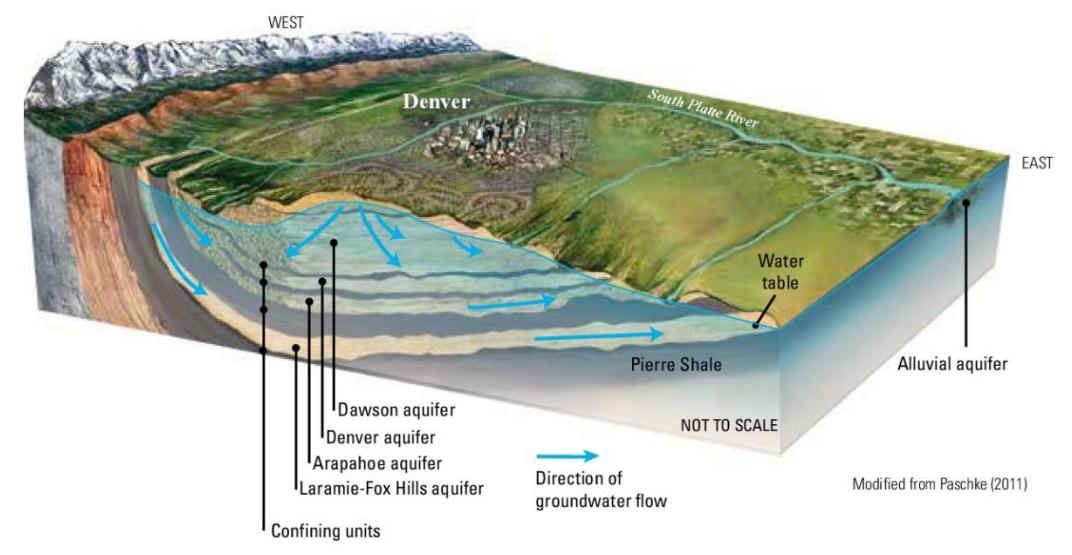
Douglas County’s final-draft 2050 water plan projects that water supplies will remain above demand as the county grows, but the surplus will shrink and depend on projects being financed and built on schedule.
The county water plan projects 105,184 acre-feet of annual supply against 67,434 acre-feet of demand in 2025, a 56% surplus. By 2050, supply is projected to reach 135,657 acre-feet while demand rises to 98,790 acre-feet, reducing the surplus to 37%. The population is projected to grow from about 401,211 in 2025 to 550,552 in 2050.
Those figures are projections, not guarantees. They depend on water-provider projects being financed and built on schedule, projected sources producing their full yields, and surface water and groundwater remaining reliable as hydrologic conditions change.
Groundwater and drought risks
Douglas County has about 10,500 permitted groundwater wells, 93% of them low-capacity residential wells. The plan estimates about 710,000 acre-feet per year of physically available Denver Basin groundwater but cautions that not all of it may be economically or practically extractable.
The Denver Basin aquifers have very low recharge and are considered essentially nonrenewable. The plan says heavily pumped areas are experiencing declining water levels and volumes. Drought, changing snowpack and stream flows, declining soil moisture and rising evaporation could further affect supplies and demand.
The plan distinguishes between “paper water” — legal rights or planned volumes — and water that can actually be produced. Sedalia Water and Sanitation District projects a supply-to-demand factor below 1.0 and is evaluating how to address the gap, the plan says.
Conservation could reduce demand. The plan estimates that conservation by Highlands Ranch Water, Parker Water and Sanitation District, and Castle Rock could reduce their combined 2050 demand by an average of 12%, or about 11,900 acre-feet annually. That is a modeled potential reduction, not a guaranteed saving.
Growth and renewable water
The plan recommends discouraging urban-scale development that relies solely on nonrenewable groundwater, particularly development that could affect shallow aquifers or nearby rural wells. It favors growth in areas served by existing water providers and renewable supplies.
For projects proposing to use Denver Basin groundwater, the recommendations call for aquifer-specific analysis, conservative estimates of available water and evaluation of impacts on shallow aquifers and rural wells. The recommendations are part of the final draft and do not represent adopted regulations.
The plan also sets an objective for water providers to develop an additional 15,000 acre-feet per year of renewable supplies. Douglas County is not itself a water provider; it would support providers through coordination, research and infrastructure planning. The plan does not set a total cost or completion deadline for the objective and identifies financing, construction schedules and projected yields as risks.