
El Paso County departments seek millions for roads, wildfire evacuation planning
Public Works seeks $7 million for pavement and ongoing road and fleet increases; emergency management wants $90,000 for wildfire modeling, and the coroner requested $113,383 for a full-time morgue technician.
Published at
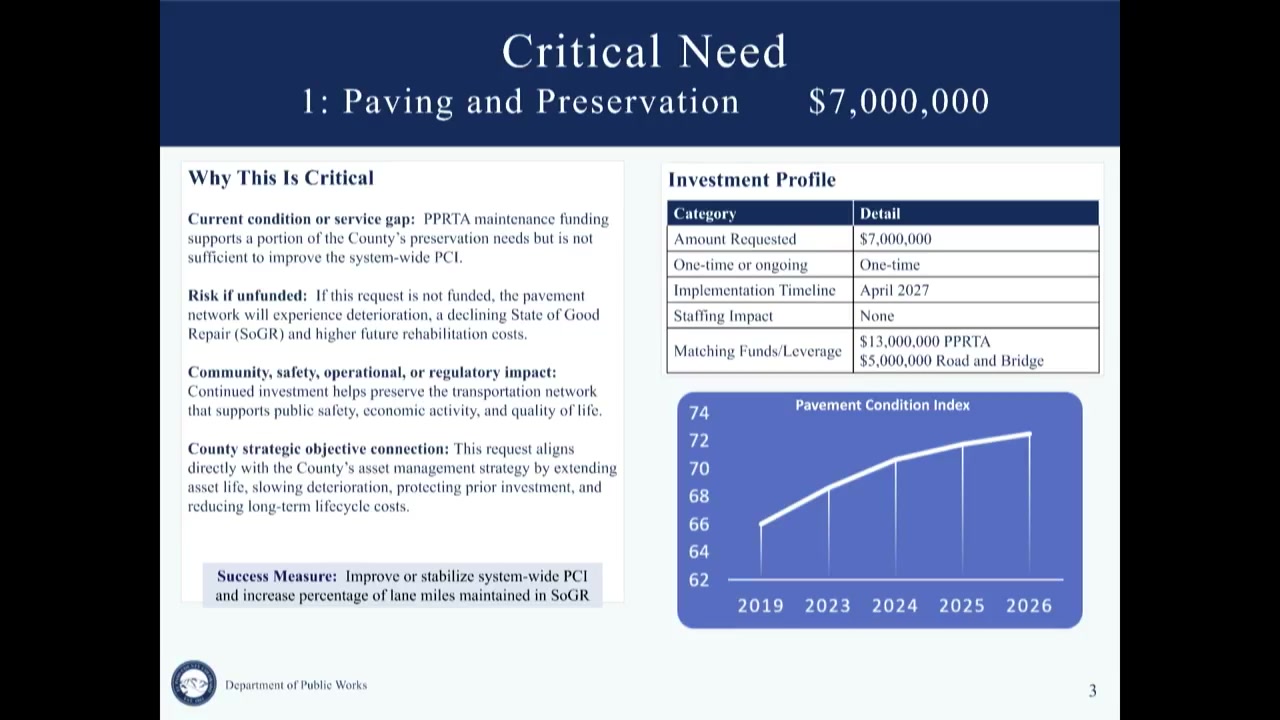
El Paso County Public Works is seeking $7 million in one-time pavement funding and $675,000 in annual increases for fleet replacement and road materials as commissioners prepare the 2027 budget. The Office of Emergency Management is also seeking a one-time $90,000 contribution for wildfire and evacuation modeling software.
The coroner requested $113,383 in ongoing 2027 funding for a full-time morgue technician. The request would shift the staffing mix from three full-time and four part-time technicians to four full-time and three part-time. The coroner cited rising case volume and difficulty maintaining consistent daily coverage with part-time staffing.
Commissioners made no budget decisions at the Oct. 27 hearing; the board’s minutes classify the budget presentations as non-action items. The Nov. 10 budget direction hearing is the next scheduled opportunity for them to provide guidance. Final budget action is expected in December.
Public Works Director Jack Ladley said at the Oct. 27 budget hearing that the $7 million would fund pavement preservation on about 75 lane miles. Combined with $13 million from the Pikes Peak Rural Transportation Authority and $5 million from the Road and Bridge Fund, it would bring annual pavement investment to about $25 million. Ladley estimated the additional work could improve the county’s pavement condition index by 0.5 to 0.75 points. Without the added investment, he warned, pavement conditions could decline and repairs could be deferred, potentially raising future costs.
The department’s other requests address rising operating costs. Ladley said the recurring $275,000 fleet-replacement increase would help maintain the existing replacement cycle, not expand the fleet. He cited cost increases since 2019 of about 54% for medium- and heavy-duty equipment and nearly 51% for light vehicles, and said delayed replacements can mean higher maintenance costs, more downtime and less reliability.
The recurring $400,000 increase for road-and-bridge materials would cover supplies such as asphalt, gravel and anti-skid material. Ladley said some material costs had risen more than 50% since 2019 and Class 5 gravel had more than doubled. He described the request as a way to maintain current maintenance production, not expand it.
The Office of Emergency Management’s presentation describes Ladris Core as regional wildfire and evacuation modeling software. Its simulations can help planners identify communities at risk, estimate evacuation timelines, and spot hazard areas and traffic bottlenecks.
Commissioners also discussed the cost of maintaining gravel roads and when paving might make sense.