
Colorado Springs draft parks plan prioritizes reinvestment, estimates $657 million need
The 10-to-15-year framework estimates a $52.2 million average annual funding gap in its first three phases and lists options for future study, not approved spending.
Published at
Colorado Springs’ draft 2026 Park System Master Plan would prioritize repairing and sustaining existing parks before major expansion, estimating $657.1 million in additional capital investment over its planning horizon. The draft plan is a strategic framework, not a project-by-project construction schedule.
The plan estimates a $125.4 million backlog of deferred reinvestment and nearly $837.5 million in current replacement value. The estimates are in 2026 dollars and draw on benchmarks, regional construction costs and available asset assessments. The plan cautions that the backlog may be understated because detailed condition assessments are not available for all assets.
For its first three phases, spanning 13 years, the plan estimates $789 million in total costs, including new capital work, backlog reduction, asset replacement and additional operating costs. Assuming $8.5 million a year in existing capital funding, it calculates an average annual gap of about $52.2 million. The plan describes current annual capital funding capacity as $5 million to $8.5 million; the gap is an estimate, not an approved appropriation. The $657.1 million figure covers additional capital investment, not all costs in the $789 million estimate.
Proposed early work includes developing a sustainable reinvestment funding strategy, setting condition and replacement standards, and establishing systemwide asset management and public reporting. The 2027–2029 first phase would build that foundation. The 2030–2034 phase would focus on stabilizing the system and addressing deferred maintenance and safety needs. Later phases envision broader recreation, access and connectivity improvements, with timing and scope dependent on funding and operating capacity.
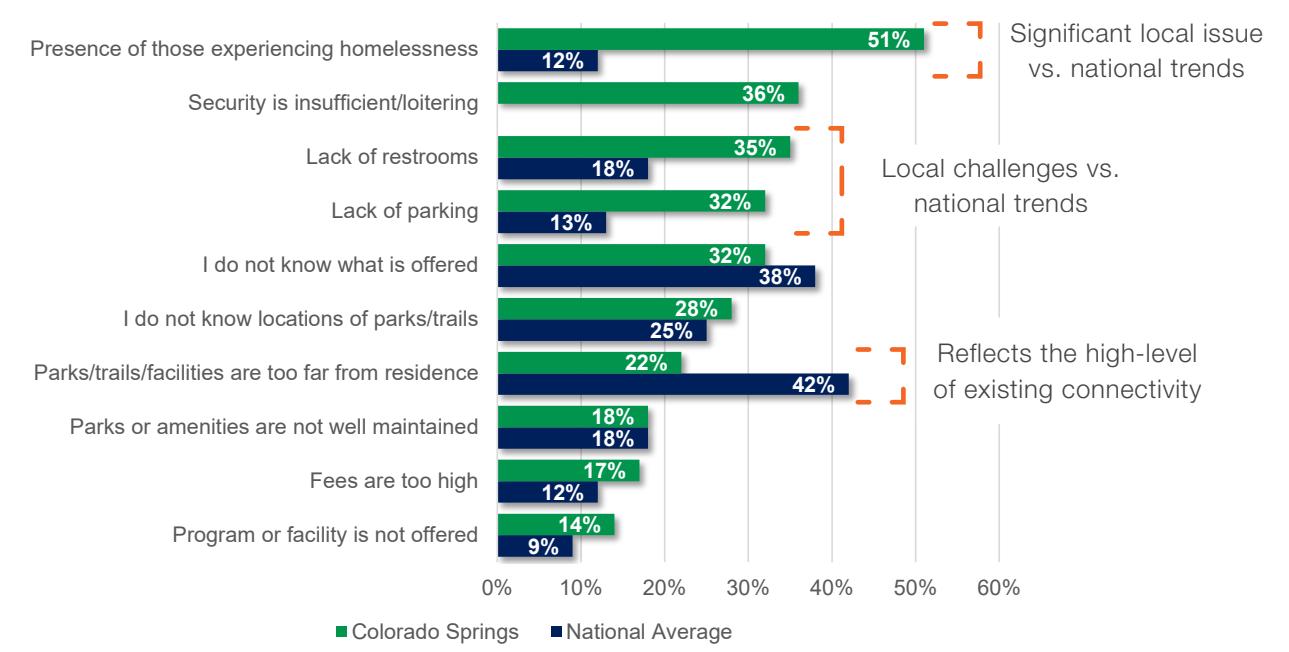
Revisions described in a staff presentation to City Council elevate safety and communication and add a coordinated Safe and Welcoming Parks Strategy. It includes work on park design, lighting, sanitation, behavioral and unhoused issues, and coordination with public-safety and human-service providers. The revisions also strengthen support for volunteers, recognize metropolitan districts’ contributions to parks and recreation, and call for continued coordination with those districts. They set a goal of working toward a publicly accessible city- or district-owned park within a half-mile, or a 10-minute walk, of each resident’s home, with health and accessibility among the factors considered in prioritizing access.
The plan describes systemwide needs involving playgrounds, trails, restrooms, bridges, irrigation systems, athletic fields, recreation facilities and cultural assets. Mini parks received the lowest average score in the plan’s park-type evaluation, which cited their small size and limited ability to provide varied recreation—not necessarily poor maintenance. The plan names Happy Hallow, Honeybear, Little Britches, Mountain View and Munchkin Playground among low-scoring mini parks, but does not rank them by repair costs. It also identifies access and connectivity gaps in parts of eastern and southeastern growth areas, while reporting that about 92% of the city is within a 10-minute walk of a park.
The revised draft proposes evaluating parkland-dedication requirements, fees-in-lieu, district-funded improvements and other development contributions. The evaluation would account for existing obligations, avoid duplicative burdens, and consider housing affordability and equitable cost distribution. These are matters for further analysis, not selected funding mechanisms or approved spending.
At a Nov. 9 work session, parks staff said it was looking to bring the resolution back to City Council on Dec. 8. The council chair said the timing would be discussed during agenda preparation; the meeting did not confirm final placement on that agenda, and no adoption vote occurred.