
Colorado Springs advances 4.279-mill 2027 property-tax levy on first reading
Council rejected an amendment to restore a proposed tax credit that would have lowered the effective levy; the first-reading vote is not final.
Published at
Colorado Springs City Council advanced a 4.279-mill property-tax levy for 2027 on first reading Nov. 10, after rejecting an amendment to restore a temporary credit that would have lowered the effective levy. The council passed the levy ordinance 6-3 and rejected the amendment 4-5, according to its approved minutes.
Councilmembers Casey, Crow-Iverson and Risley opposed the levy. The amendment would have restored a 1.07-mill credit, capping the effective levy at 3.209 mills. The credit had been removed during budget markup.
Finance staff’s earlier proposal was a balanced $465.5 million General Fund budget for 2027, $38.2 million more than the amended 2026 budget. It included a proposed $9.37 million property-tax credit. Council discussed the plan at an Oct. 15 work session but took no formal budget action; finance staff outlined the proposal there.
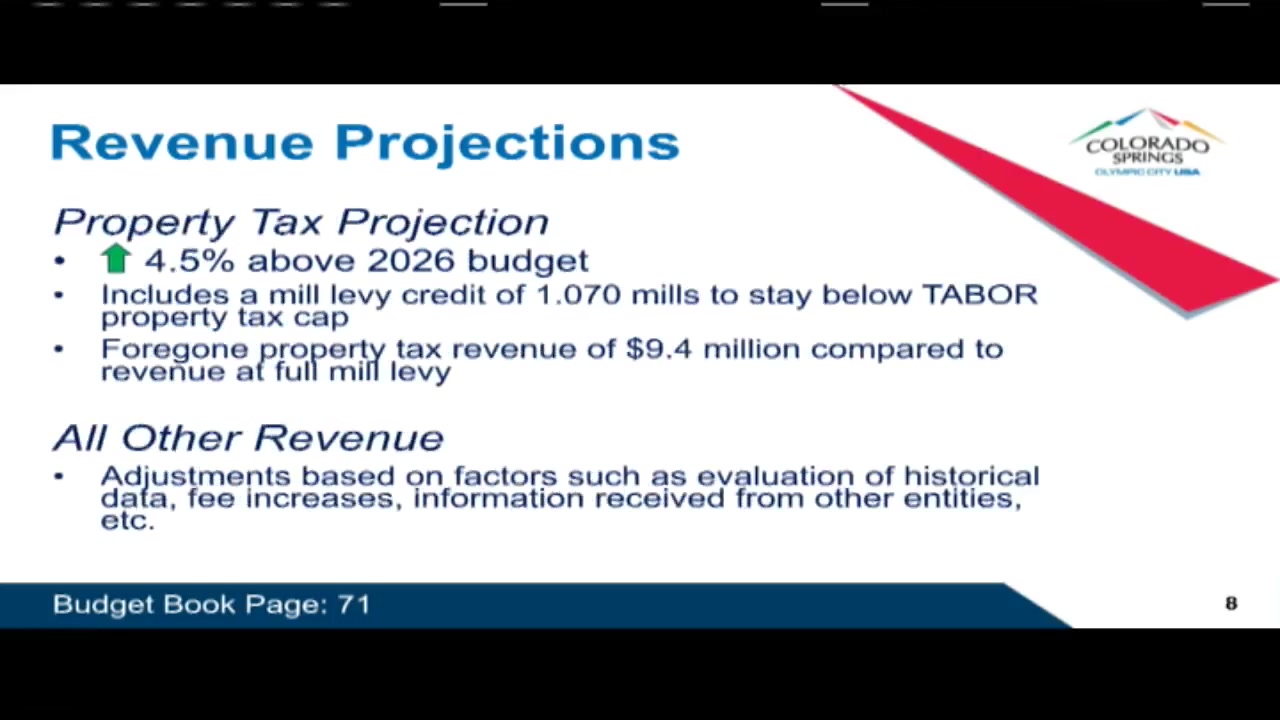
An earlier draft ordinance proposed a 1.070-mill credit against the 4.279-mill general operating levy, for a net levy of 3.209 mills on most taxable property. It also proposed a credit for the full 3.209-mill levy on taxable business personal property. The draft estimated $28.1 million in General Fund property-tax revenue. The proposed credit was intended to keep collections below the Taxpayer’s Bill of Rights (TABOR) property-tax limit: the city estimated collections without the credit would exceed the limit by about $9.4 million, the draft ordinance says.
Sales and use taxes account for 58% of projected General Fund revenue. Staff forecast 2.8% ongoing sales-tax growth from its 2026 year-end estimate, or 3.5% including revenue attributed to two new tax-enforcement positions. Property-tax revenue was projected to grow 4.5%. The budget proposal also included about $12.3 million in one-time revenue for uses such as reserves and capital projects. Staff said it intended to avoid using those funds for ongoing costs because temporary revenue cannot reliably support recurring expenses. The earlier budget presentation estimated that the credit would reduce city collections by $9.37 million but did not estimate its effect on an individual property owner’s bill.
Staff estimated the General Fund reserve level at 21.8% entering 2026, above the 16.7% benchmark it attributed to the Government Finance Officers Association. That was a 2026 estimate, not a projection of the 2027 reserve balance. Personnel costs—salaries, benefits and pensions—made up about 72% of proposed General Fund spending and were projected to rise about $19.1 million over the amended 2026 budget. The proposal included roughly $2 million for civilian performance increases averaging 2%, $812,000 for eligible civilian employees’ progression increases of up to 4%, and market adjustments and step progressions for sworn police and fire employees. Staff said the proposed sworn market adjustments would move each rank about one-third of the way toward market. The salary schedule was expected to come before council separately.
At an Oct. 29 budget-markup work session, councilmembers informally indicated support for $196,000 for two parks maintenance positions and $55,000 for park projects, including a graffiti-removal machine and repairs to the Deerfield Hills spray ground. They took no formal vote on the proposed spending at the work session.
The Nov. 10 vote was a first-reading action; it does not establish final passage of the levy or the amount individual property owners will owe.